
Hiring a residential contractor Delaware homeowners can trust means looking past the sales pitch and checking three things: state registration, project-specific experience, and a written payment schedule. Delaware's licensing system works differently than most states, which trips up even careful homeowners. Get the vetting process wrong and you're exposed on a project that, for custom work like a basement renovation or a built-in bar, can run well into six figures.
Delaware Doesn't Issue a General Contractor License. Here's What It Issues Instead
Most homeowners assume "licensed contractor" means the same thing in every state. In Delaware it doesn't.
General contractors in Delaware do not need to pass a trade exam or hold a professional license from the state, but every contractor performing construction services must register with the Department of Labor under the Delaware Contractor Registration Act and obtain a business license from the Division of Revenue. That registration requirement isn't optional or size-based. Delaware law requires construction service businesses to register with the Office of Contractor Registration at the Delaware Department of Labor before beginning work in the state, in addition to registering with the Division of Revenue and reporting hiring.
Here's what that means in practice when you're vetting bids:
- Business license — issued by the Division of Revenue, roughly $75 a year, renews every December 31.
- Contractor registration — issued by the Department of Labor's Office of Contractor Registration, required before any construction or maintenance work begins, no exam or experience needed.
- Non-resident bond —
non-resident contractors must supply a bond equal to 6% of the contract(s) totaling $20,000 or more.
- Trade licenses — electricians, plumbers, and HVAC technicians carry separate Division of Professional Regulation credentials; a general or design-build contractor's registration does not cover these trades.
Skipping registration isn't a paperwork technicality for the contractor either. Contractors who do not comply with the state's licensing requirements are subject to civil penalties of up to $10,000. Ask for the registration number up front and cross-check it before you pay a deposit.

What a Full-Service Residential Contractor in Delaware Should Actually Cover
Plenty of companies calling themselves a "residential contractor Delaware" wide search ads route to handle routine repairs and not much else. A design-build contractor working on higher-end interior projects is a different scope of work entirely, and the vetting checklist changes with it.
Signature Spaces: Wine Cellars, Bars, Saunas, and Basements
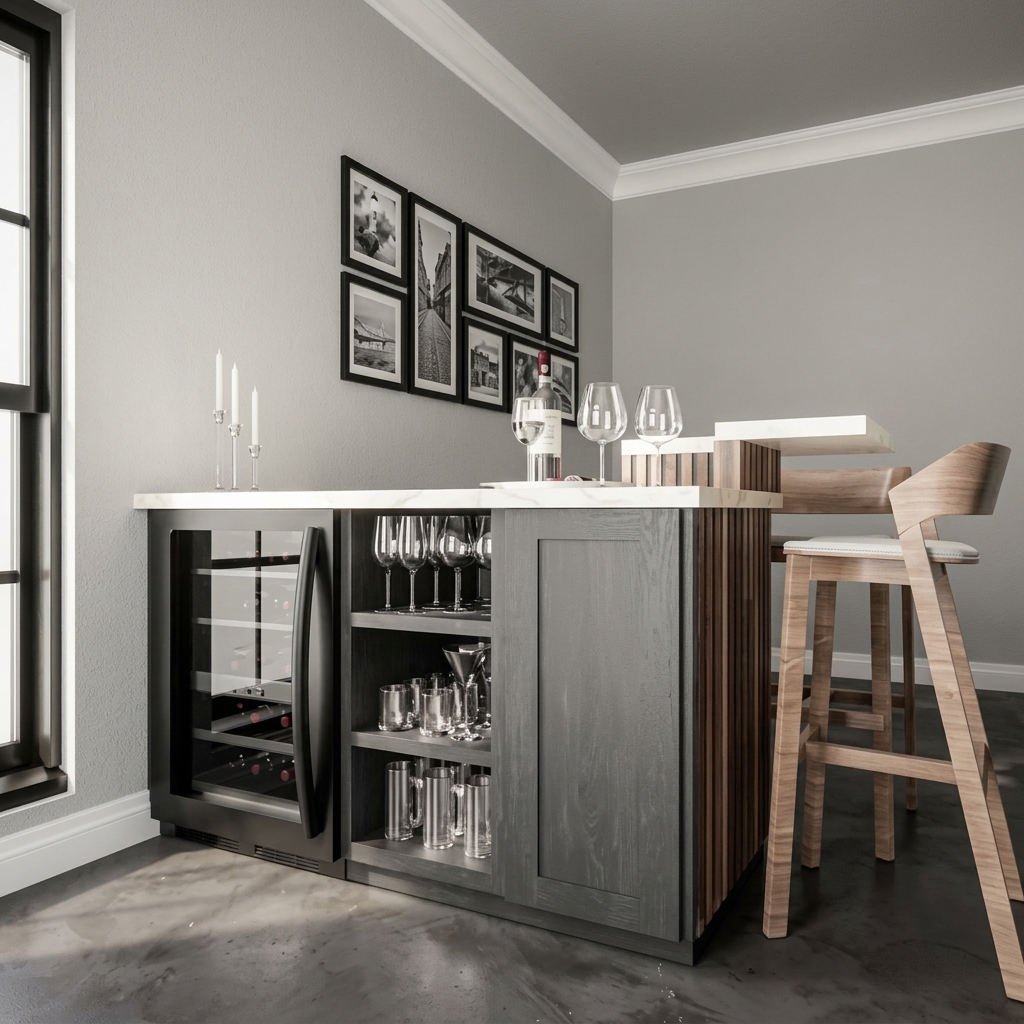
These are rooms built around mechanical systems, not just finishes. A custom wine cellar has to manage humidity and temperature as a single engineered system, not an afterthought bolted onto a finished basement. The same logic applies to an upscale bar build, a custom sauna, or a full luxury basement renovation. All four fall under our signature spaces work, and it's a category most generalist remodelers in the state simply don't offer.
In our experience building these rooms across the Mid-Atlantic, Delaware's humid summers and damp basements are the single biggest reason a DIY-adjacent vapor barrier or an undersized cooling unit fails within the first year. Below-grade spaces here need a vapor barrier and cooling system sized to the room's actual insulation package, not a catalog unit installed to spec sheet minimums.
Luxury Interiors: Remodeling, Kitchens, Baths, and Millwork
High-end remodeling covers whole-room and whole-floor renovations. Kitchen and bath work sits under the same umbrella but deserves its own scrutiny, since clearance and layout mistakes are expensive to fix after cabinets are installed. The National Kitchen & Bath Association publishes planning guidelines that serve as the industry reference for Certified Kitchen and Bath Designers working on code-compliant layouts. Ask any contractor bidding on a kitchen cabinet design and build or bathroom design and build project whether their layouts follow those clearance standards.
Furniture-grade millwork is its own skill set again, closer to cabinetmaking than framing carpentry, and it's worth asking to see finished samples before committing.
Surfaces and Finishes: Flooring and Stone
Flooring installation and slab stone design round out the surfaces and finishes category. Stone selection matters more than most homeowners expect: it generally makes sense to seal marble and granite countertops with a quality sealer rated for a ten- to fifteen-year life and resistance to water and oil-based stains. A contractor who can't answer a basic sealing question on the spot probably isn't fabricating the stone in-house.

What Delaware's Climate and Counties Mean for Your Project
Delaware runs three counties with their own permitting quirks: New Castle, Kent, and Sussex. A contractor who primarily works New Castle County jobs may not have current relationships with Sussex County's building office, and permit timelines can shift as a result. Confirm which counties your bidders actually pull permits in regularly, not just which counties they're willing to drive to.
Climate matters just as much as geography. The Mid-Atlantic's humid summers and freeze-thaw winters put real stress on below-grade spaces, finished basements, and any room with sensitive climate requirements. This is the reason moisture control gets more attention in our proposals than it does in a typical remodeling quote.
What It Costs and How Long It Takes
Exact pricing depends on finishes, square footage, and site conditions, so treat any flat number with suspicion. Industry benchmarks are more useful than a single average. NAHB's own market index treats large remodeling projects as $50,000 or more and moderate projects as between $20,000 and $50,000 — a useful way to size up where your project sits before you start comparing bids.
| Project type | Typical scope driver | Rough timeline |
|---|---|---|
| Kitchen or bath remodel | Layout changes, cabinetry, fixtures | 6–12 weeks |
| Luxury basement renovation | Square footage, mechanical systems | 8–16 weeks |
| Custom wine cellar | Cooling system, racking, glass enclosures | 6–10 weeks |
| Whole-home high-end remodel | Number of rooms, structural changes | 4–9 months |
Demand for this tier of remodeling hasn't slowed. Virginia's remodeling spending alone grew $631.6 million year over year , and neighboring Delaware homeowners are competing for many of the same specialty trades and material lead times. Book consultations early if you're targeting a specific season.
Questions to Ask Before You Sign
- Can you provide your Delaware contractor registration number right now?
- Who is actually on-site day to day versus who's selling the job?
- What's the payment schedule, and is it tied to completed milestones rather than calendar dates?
- Have you built this specific type of space before (wine cellar, sauna, custom bar) or is this your first one?
- Who handles the permit applications in this county, and what's the current turnaround?
- What's your warranty on millwork, cabinetry, and mechanical systems separately?
Get the answers in writing. A contractor who hesitates on any of these is telling you something.
Why Specialized, Regional Experience Matters
A generalist can hang drywall and swap a vanity. Building a cellar that holds temperature within a degree, or a basement that won't develop a moisture problem behind the drywall in year two, takes a different kind of experience. We build signature spaces and high-end interiors across Delaware and the surrounding region, and that focus is deliberate. Explore our work to see the kind of detail that separates a design-build specialist from a general remodeler, or review projects specific to Delaware. We also serve Maryland, Virginia, and Washington D.C., and the vetting standards in this guide hold up across all four markets. If you're comparing notes with a Virginia project, our guide to hiring a custom home general contractor in Virginia covers the same registration-and-vetting logic from that state's side.
Ready to talk through your project? Start Your Cellar Project and we'll walk through scope, timeline, and budget before anything gets signed.
FAQ
Do I need a license to hire a residential contractor in Delaware?
No statewide trade license exists for general contractors. Under the Delaware Contractor Registration Act, all businesses performing "construction services" must register with the Department of Labor's Office of Contractor Registration before work begins, and this applies to general contractors, subcontractors, and specialty trade contractors alike, with no exam, experience, or education requirement. Specialty trades like electrical and plumbing carry their own separate licenses.
How much does it cost to register as a contractor in Delaware?
The yearly fees are $200 for private construction or $300 for public construction , on top of the $75 annual business license from the Division of Revenue. Costs for your specific project will vary far more based on materials and scope than on the contractor's registration fees.
Is contractor registration mandatory for small jobs too?
Yes. Anyone who performs construction or maintenance services within Delaware must register with the Department of Labor , regardless of project size or whether the contractor is a sole proprietor or a larger company.
How do I verify a contractor's registration in Delaware?
Ask for the registration number directly and check it against the state's public contractor listing. Delaware provides a public portal for constituents to view compliant contractors for services , which is the fastest way to confirm a contractor is in good standing before you sign anything.
What's the difference between a general remodeler and a design-build specialty contractor?
A general remodeler typically handles standard repairs and cosmetic updates. A design-build specialty contractor manages engineering-heavy spaces, climate-controlled wine cellars, custom millwork, and whole-room renovations, from design through final install, usually with an in-house team rather than rotating subcontractors.
How long does a custom basement or wine cellar project take in Delaware?
Most luxury basement renovations run 8 to 16 weeks depending on mechanical complexity, and custom wine cellars typically run 6 to 10 weeks once cooling systems and racking are specified. Permitting timelines vary by county and can add several weeks on either end.